
Research
Statutes of limitations by state, quoted from each official code
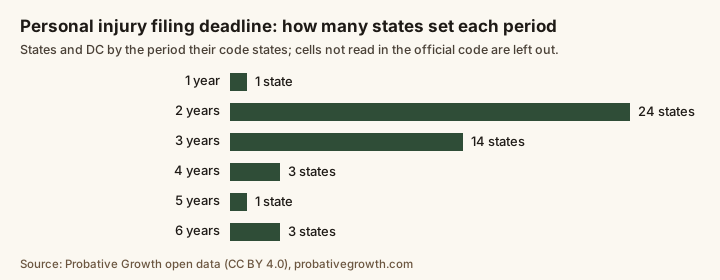
We read the statute of limitations for five kinds of claims in all 50 states and DC in each state’s official code, and quoted it. 193 of the 255 cells are verified in the official code; 32 more come from court opinions that quote or apply the statute (marked S); the other 30 are marked U, never guessed. For personal injury, 24 of the 46 verified states give 2 years.
Before you use this table
Key facts
- Cells verified in the official code
- 193
- of 255: 51 jurisdictions × 5 claim types
- Most common injury period
- 2 years
- in 24 of 46 verified states
- Cells from court opinions (S)
- 32
- secondary: the opinion quotes or applies the statute
- States with all five verified
- 14
- the rest have one or more U cells
Download the table (CSV) Go to the table Free under CC BY 4.0. No email or login.
What did we find?
- Personal injury: 2 years in 24 states, 3 years in 14 states, 4 years in 3 states, 6 years in 3 states, 1 year in Kentucky and 5 years in Missouri. The shortest verified period is 1 year (Kentucky); the longest is 6 years (Maine, Minnesota and North Dakota).
- Medical malpractice: 2 years in 28 states, 3 years in 9 states, 1 year in 4 states, 30 months in New York and 4 years in Minnesota. 30 of the 43 verified states also set an outer limit (a statute of repose) in the text we read.
- Wrongful death: 2 years in 29 states, 3 years in 12 states and 1 year in Louisiana. In District of Columbia, Louisiana, Maine, Minnesota, Missouri, Nebraska, New York, North Carolina, North Dakota, Oregon, Utah, Vermont and Wyoming, the wrongful-death period differs from the injury period.
- Product liability: only 16 states have a limitations period that names product claims in the code text we read; elsewhere the cell comes from a court opinion (S) or is U; see the injury column for that state.
- Property damage: 2 years in 14 states, 3 years in 14 states, 6 years in 8 states, 5 years in 5 states, 4 years in 4 states and 10 years in Rhode Island.
The table: every state and DC
Read across a row for one state. Each verified cell gives the period, the statute it comes from (linked to the official code) and the statute’s own words under “Statute text”. “General period” means the state’s general or catch-all period, because the statute does not name that claim. S means the cell comes from a court opinion that quotes or applies the statute (secondary). U means we did not verify the cell; it says nothing about the law.
| State | Personal injury | Medical malpractice | Wrongful death | Product liability | Property damage |
|---|---|---|---|---|---|
| Alabama | 2 years Ala. Code § 6-2-38(l) Statute text“(l) All actions for any injury to the person or rights of another not arising from contract and not specifically enumerated in this section must be brought within two years.” Covers injury to the person or rights of another not arising from contract and not otherwise listed in the section. Read October 28, 2026 in a browser (the site refuses scripts). | 2 years Ala. Code § 6-5-482(a) Statute text“All actions against physicians, surgeons, dentists, medical institutions, or other health care providers for liability, error, mistake, or failure to cure, whether based on contract or tort, must be commenced within two years next after the act, or omission, or failure giving rise to the claim, and not afterwards” If the claim could not reasonably have been discovered within two years, six months from discovery, with a four-year outer limit. Special rule for minors under four. Read October 28, 2026 in a browser (the site refuses scripts). | 2 years Ala. Code § 6-2-38(a) Statute text“(a) An action by a representative to recover damages for wrongful act, omission, or negligence causing the death of the decedent under Sections 6-5-391 and 6-5-410 must be commenced within two years from the death.” Runs from the death. Read October 28, 2026 in a browser (the site refuses scripts). | U No statute naming this claim found | 6 years Ala. Code § 6-2-34(2) Statute text“(2) Actions for any trespass to real or personal property;” Trespass to real or personal property. § 6-2-38(l) sets two years for other injury to the rights of another not arising from contract and not otherwise listed. Read October 28, 2026 in a browser (the site refuses scripts). |
| Alaska | two years AS 09.10.070(a)(2) Statute text“Actions for torts, for injury to personal property, for certain statutory liabilities, and against peace officers and coroners to be brought in two years.” Subsection (a)(2) lists personal injury or death; period runs from accrual of the cause of action. Read October 28, 2026. | U No statute naming this claim found | two years AS 09.55.580(a) Statute text“The action shall be commenced within two years after the death, and the damages therein shall be the damages the court or jury may consider fair and just.” Runs from the death. AS 09.10.070(a)(2) also lists 'personal injury or death' with a two-year period from accrual. Read October 28, 2026. | U No statute naming this claim found | two years AS 09.10.070(a)(3) Statute text“Actions for torts, for injury to personal property, for certain statutory liabilities, and against peace officers and coroners to be brought in two years.” Item (a)(3) covers taking, detaining, or injuring personal property. Trespass upon real property is separate: AS 09.10.050 states six years ("Unless the action is commenced within six years, a person may not bring an action for waste or trespass upon real property."). Read October 28, 2026. |
| Arizona | two years A.R.S. § 12-542(1) Statute text“within two years after the cause of action accrues, and not afterward, the following actions: 1. For injuries done to the person of another” Runs from accrual. Read October 28, 2026. | two years A.R.S. § 12-542(1) Statute text“within two years after the cause of action accrues, and not afterward, the following actions: 1. For injuries done to the person of another including causes of action for medical malpractice as defined in section 12-561.” Same two-year period as personal injury; within 12-542 with the general list. Read October 28, 2026. | two years A.R.S. § 12-542(2) Statute text“2. For injuries done to the person of another when death ensues from such injuries, which action shall be considered as accruing at the death of the party injured.” Accrues at the death of the injured party; two-year period is in the section lead-in ('within two years after the cause of action accrues'). Read October 28, 2026. | 2 years A.R.S. § 12-551 Statute text“A product liability action as defined in section 12-681 shall be commenced and prosecuted within the period prescribed in section 12-542, except that no product liability action may be commenced and prosecuted if the cause of action accrues more than twelve years after the product was first sold for use or consumption” Period is set by reference to 12-542 (two years). Twelve-year outer limit from first sale, with an exception for negligence of the manufacturer/seller or breach of express warranty. Read October 28, 2026. | two years A.R.S. § 12-542(3) Statute text“3. For trespass for injury done to the estate or the property of another.” Two-year lead-in applies; items 4-5 cover taking/detaining/converting goods. Read October 28, 2026. |
| Arkansas | three years S Ark. Code Ann. § 16-56-105(1) Court opinion text“Generally, tort claims are subject to a three-year statute of limitations which begins to run when a negligent act occurs. Grand Valley Ridge, LLC v. Metro. Nat’l Bank, 2012 Ark. 121, at 18, 388 S.W.3d 24, 35; see also Ark. Code Ann. § 16-56-105(1).” Supreme Court of Arkansas, Marcum v. Hodge, 2023 Ark. 103 (car-accident negligence claim), decided June 15, 2023. Secondary: the opinion quotes or applies the statute. Three years from the negligent act; the opinion states it for tort claims generally and the Arkansas Code text itself (LexisNexis) could not be opened here. Read October 28, 2026 in a browser (the site refuses scripts). | two years S Ark. Code Ann. § 16-114-203 Court opinion text“Arkansas law sets a two-year statute of limitations on all medical-injury claims. Ark. Code Ann. § 16-114-203.” U.S. District Court, Eastern District of Arkansas (Western Division), Electa Branch, Administrator of the Estate of Willie Branch, Jr. v. Matthew D. Cox, M.D., No. 4:17CV00429 JLH, decided January 18, 2018. Secondary: the opinion quotes or applies the statute. Two years for medical-injury claims; a federal court applying Arkansas law, and the opinion does not quote the statute itself. The Arkansas state-court opinions that state this could not be opened (the court site put up a CAPTCHA, which was not bypassed). Read October 28, 2026. | three years S Ark. Code Ann. § 16-62-102(c)(1) Court opinion text“the three-year statute of limitations for wrongful death actions expired while the claim for workers’ compensation benefits was pending before the Commission. See Ark. Code § 16-62-102(c)(1).” U.S. Court of Appeals for the Eighth Circuit, Frisby v. Milbank Manufacturing Co., No. 11-1858, decided July 31, 2012. Secondary: the opinion quotes or applies the statute. Three years for wrongful death (the clock runs from the death; shorter two-year medical-injury period applies if the death comes from medical injury); a federal court applying Arkansas law in 2012, so a later amendment of § 16-62-102 was not ruled out. Read October 28, 2026. | three years S Ark. Code Ann. § 16-116-103 Court opinion text“The Arkansas Products Liability Act of 1979, Ark. Code Ann. §§ 16-116-101 through 16-116-107 (Repl. 2006 & Supp. 2009), provides a three-year statute of limitations for all product liability actions. Ark. Code Ann. § 16-116-103.” Arkansas Court of Appeals (Division III), IC Corp. v. Hoover Treated Wood Products, Inc., 2011 Ark. App. 589 (No. CA10-1266), decided October 5, 2011. Secondary: the opinion quotes or applies the statute. Three years from the date the death, injury, or damage occurs, with a discovery rule; the 2011 opinion is the newest one found whose text could be read. Read October 28, 2026 in a browser (the site refuses scripts). | U Code only on a contracted publisher’s site; no court opinion found |
| California | 2 years Cal. Code Civ. Proc. § 335.1 Statute text“Within two years: An action for assault, battery, or injury to, or for the death of, an individual caused by the wrongful act or neglect of another.” Read October 28, 2026 in a browser (the site refuses scripts). | 1 year Cal. Code Civ. Proc. § 340.5 Statute text“the time for the commencement of action shall be three years after the date of injury or one year after the plaintiff discovers, or through the use of reasonable diligence should have discovered, the injury, whichever occurs first” Applies to actions for injury or death against a health care provider based on professional negligence. Separate rules for minors are in the same section. Read October 28, 2026 in a browser (the site refuses scripts). | 2 years Cal. Code Civ. Proc. § 335.1 Statute text“Within two years: An action for assault, battery, or injury to, or for the death of, an individual caused by the wrongful act or neglect of another.” The same section covers injury to and the death of an individual. Read October 28, 2026 in a browser (the site refuses scripts). | U No statute naming this claim found | 3 years Cal. Code Civ. Proc. § 338(b), (c)(1) Statute text“An action for trespass upon or injury to real property.” Item (c)(1) gives the same period for taking, detaining, or injuring goods or chattels. Read October 28, 2026 in a browser (the site refuses scripts). |
| Colorado | two years C.R.S. § 13-80-102(1)(a) Statute text“must be commenced within two years after the cause of action accrues, and not thereafter: (a) Tort actions, including but not limited to actions for negligence, trespass,” General tort period. Tort actions for bodily injury arising out of motor vehicle use or operation are three years under § 13-80-101(1)(n). Edition read: C.R.S. 2024 (the General Assembly's PDF); current-year edition not located on the official host. Read October 28, 2026. | two years C.R.S. § 13-80-102.5(1) Statute text“shall be maintained unless such action is instituted within two years after the date that such action accrues pursuant to section 13-80-108 (1), but in no event shall an action be brought more than three years after the act or omission which gave rise to the action.” Applies to health-care institutions and professionals. Exceptions in subsection (3) include knowing concealment, unauthorized foreign object, injury and cause not knowable, and minors under eight in certain cases. Edition read: C.R.S. 2024 (the General Assembly's PDF); current-year edition not located on the official host. Read October 28, 2026. | two years C.R.S. § 13-80-102(1)(d) Statute text“(d) All actions for wrongful death, except as described in subsection (2) of this section;” Item (1)(d) lists 'All actions for wrongful death'; § 13-80-108(2) says the cause accrues on the date of death. Subsection (2): four years for wrongful death against a defendant who committed vehicular homicide and leaving the scene. Edition read: C.R.S. 2024 (the General Assembly's PDF); current-year edition not located on the official host. Read October 28, 2026. | two years C.R.S. § 13-80-106(1) Statute text“or the failure to provide proper instructions for the use of any product shall be brought within two years after the claim for relief arises and not thereafter.” Applies to actions against a manufacturer or seller of a product for personal injury, death, or property damage, except those governed by § 4-2-725. Edition read: C.R.S. 2024 (the General Assembly's PDF); current-year edition not located on the official host. Read October 28, 2026. | two years C.R.S. § 13-80-102(1)(a) Statute text“must be commenced within two years after the cause of action accrues, and not thereafter: (a) Tort actions, including but not limited to actions for negligence, trespass,” Tort actions including trespass fall under the two-year tort item; actions for taking, detaining, or converting goods or chattels are three years under § 13-80-101(1)(h). Edition read: C.R.S. 2024 (the General Assembly's PDF); current-year edition not located on the official host. Read October 28, 2026. |
| Connecticut | two years Conn. Gen. Stat. § 52-584 Statute text“injury to the person, or to real or personal property, caused by negligence, or by reckless or wanton misconduct, or by malpractice of a physician, surgeon, dentist, podiatrist, chiropractor, advanced practice registered nurse, hospital or sanatorium, shall be brought but within two years” Applies to injury to the person caused by negligence or reckless or wanton misconduct. Runs from the date injury is first sustained or discovered or should have been discovered; three-year outer limit from the act or omission. Other torts fall under 52-577 (three years from the act). Read October 28, 2026. | two years Conn. Gen. Stat. § 52-584 Statute text“injury to the person, or to real or personal property, caused by negligence, or by reckless or wanton misconduct, or by malpractice of a physician, surgeon, dentist, podiatrist, chiropractor, advanced practice registered nurse, hospital or sanatorium, shall be brought but within two years” Names malpractice of a physician, surgeon, dentist, podiatrist, chiropractor, advanced practice registered nurse, hospital or sanatorium. Three-year outer limit from the act or omission. Read October 28, 2026. | two years Conn. Gen. Stat. § 52-555(a) Statute text“provided no action shall be brought to recover such damages and disbursements but within two years from the date of death, and except that no such action may be brought more than five years from the date of the act or omission complained of.” Two years from date of death; five-year outer limit from the act or omission. Subsection (b) allows suit at any time after certain homicide convictions or not-guilty-by-reason findings. Read October 28, 2026. | three years Conn. Gen. Stat. § 52-577a(a) Statute text“No product liability claim, as defined in section 52-572m , shall be brought but within three years from the date when the injury, death or property damage is first sustained or discovered or in the exercise of reasonable care should have been discovered” Ten-year outer limit from the date the party last parted with possession or control of the product, subject to subsections (c)-(e). Read October 28, 2026. | two years Conn. Gen. Stat. § 52-584 Statute text“injury to the person, or to real or personal property, caused by negligence, or by reckless or wanton misconduct, or by malpractice of a physician, surgeon, dentist, podiatrist, chiropractor, advanced practice registered nurse, hospital or sanatorium, shall be brought but within two years” Applies to injury to real or personal property caused by negligence or reckless or wanton misconduct. Three-year outer limit from the act or omission. Read October 28, 2026. |
| Delaware | 2 years 10 Del. C. § 8119 Statute text“No action for the recovery of damages upon a claim for alleged personal injuries shall be brought after the expiration of 2 years from the date upon which it is claimed that such alleged injuries were sustained; subject, however, to the provisions of § 8127 of this title.” Runs from the date the injuries were sustained. Read October 28, 2026. | 2 years 18 Del. C. § 6856 Statute text“No action for the recovery of damages upon a claim against a health-care provider for personal injury, including personal injury which results in death, arising out of medical negligence shall be brought after the expiration of 2 years from the date upon which such injury occurred” Runs from the date the injury occurred. If the injury was unknown and could not have been discovered with reasonable diligence during the 2 years, suit may be brought before 3 years from the injury date. Additional provisions for child sexual abuse claims and a 90-day tolling notice. Read October 28, 2026. | 2 years 10 Del. C. § 8107 Statute text“No action to recover damages for wrongful death or for injury to personal property shall be brought after the expiration of 2 years from the accruing of the cause of such action.” Runs from accrual of the cause of action. Read October 28, 2026. | U No statute naming this claim found | 2 years 10 Del. C. § 8107 Statute text“No action to recover damages for wrongful death or for injury to personal property shall be brought after the expiration of 2 years from the accruing of the cause of such action.” Covers injury to personal property. Section 8106(a) separately gives 3 years from accrual for damages for trespass. Read October 28, 2026. |
| District of Columbia | 3 years D.C. Code § 12-301(8) Statute text“(8) for which a limitation is not otherwise specially prescribed— 3 years;” Section 12-301 does not name personal injury; the 3-year residual item (8) is the general period for actions with no specially prescribed limitation. Runs from the time the right to maintain the action accrues. Read October 28, 2026. | three years S D.C. Code § 12-301(8) Court opinion text“filing the complaint within the District of Columbia’s three-year limitations period for medical malpractice actions. D.C. Code § 12-301(8) (2012 Repl.)” District of Columbia Court of Appeals, Waugh v. MedStar Georgetown University Hospital, No. 18-CV-329, decided March 14, 2019. Secondary: the opinion quotes or applies the statute. The court calls the three-year period under the residual item § 12-301(8) the limitations period for medical malpractice actions; it runs from accrual, and a 90-day pre-suit notice (D.C. Code § 16-2802) can extend it. Read October 28, 2026. | 2 years D.C. Code § 16-2702 Statute text“An action pursuant to this chapter shall be brought by and in the name of the personal representative of the deceased person, and within 2 years after the death of the person injured.” Changed from one year to 2 years by D.C. Law 19-177 (2012). Read October 28, 2026. | U No statute naming this claim found | 3 years D.C. Code § 12-301(a)(3) Statute text“(3) for the recovery of damages for an injury to real or personal property— 3 years;” Item (10) separately gives 5 years from discovery for injury to real property from toxic substances including asbestos products. Read October 28, 2026. |
| Florida | 2 years Fla. Stat. § 95.11(5)(a) Statute text“(5) WITHIN TWO YEARS. — (a) An action founded on negligence.” Heading reads 'WITHIN TWO YEARS'. Negligence period of two years in the current text (ch. 2023-223). Read October 28, 2026. | 2 years Fla. Stat. § 95.11(5)(c) Statute text“(c) An action for medical malpractice shall be commenced within 2 years from the time the incident giving rise to the action occurred or within 2 years from the time the incident is discovered, or should have been discovered with the exercise of due diligence” Two years from the incident or two years from discovery; four-year outer limit does not bar an action brought for a minor on or before the child's eighth birthday. Fraud/concealment extends to no more than 7 years from the incident. Read October 28, 2026. | 2 years Fla. Stat. § 95.11(5)(e) Statute text“(e) An action for wrongful death.” Read October 28, 2026. | 4 years Fla. Stat. § 95.11(3)(d) Statute text“(d) An action for injury to a person founded on the design, manufacture, distribution, or sale of personal property that is not permanently incorporated in an improvement to real property, including fixtures.” Fla. Stat. § 95.031(2)(b) sets a separate 12-year outer limit for products liability actions. Actions founded on negligence are listed under the two-year paragraph, § 95.11(5)(a). Read October 28, 2026. | 4 years Fla. Stat. § 95.11(3)(f), (g) Statute text“(g) An action for taking, detaining, or injuring personal property.” Item (f) gives the same period for trespass on real property. Actions founded on negligence are listed under the two-year paragraph, § 95.11(5)(a). Read October 28, 2026. |
| Georgia | two years S O.C.G.A. § 9-3-33 Court opinion text“OCGA § 9-3-33 says that, “[e]xcept as otherwise provided in this article, actions for injuries to the person shall be brought within two years after the right of action accrues[.]”” Supreme Court of Georgia, Doe v. Saint Joseph's Catholic Church, 313 Ga. 558, decided March 8, 2022. Secondary: the opinion quotes or applies the statute. Two years after the right of action accrues for actions for injuries to the person; tolling provisions elsewhere in the article can change this. Read October 28, 2026. | two years S O.C.G.A. § 9-3-71(a) Court opinion text“Georgia law also provides a two-year statute of limitations for medical malpractice claims. O.C.G.A. § 9-3-71(a).” U.S. Court of Appeals for the Eleventh Circuit (unpublished), Zamudio v. Haskins, No. 18-13534, decided June 5, 2019. Secondary: the opinion quotes or applies the statute. Two years for medical malpractice claims under § 9-3-71(a); the opinion states and cites the period but does not quote the statute text, and it does not say what the period runs from. Read October 28, 2026. | U Code only on a contracted publisher’s site; no court opinion found | two years S O.C.G.A. § 9-3-33 Court opinion text“The two year statute of limitations in § 9-3-33 also governs product liability claims that involve injury to the person.” U.S. Court of Appeals for the Eleventh Circuit (unpublished), Brown v. E.T. Browne Drug Co., No. 25-11991, decided April 23, 2026. Secondary: the opinion quotes or applies the statute. Applies because a product claim for personal injury is an action for injuries to the person; the opinion also notes a separate ten-year statute of repose from first sale for strict liability (O.C.G.A. § 51-1-11(b)(2)). Read October 28, 2026. | four years S O.C.G.A. §§ 9-3-30, 9-3-31 Court opinion text“he did not meet the four-year statutes of limitations for injuries to realty or personalty under O.C.G.A. §§ 9-3-30 and 9-3-31.” U.S. Court of Appeals for the Eleventh Circuit (unpublished), Wright v. Branch Banking and Trust Co., No. 20-13000, decided May 28, 2021. Secondary: the opinion quotes or applies the statute. Four years for injuries to realty (§ 9-3-30) or personalty (§ 9-3-31); the opinion states the period in a footnote and does not say what it runs from. The Supreme Court of Georgia quotes § 9-3-31 ("within four years after the right of action accrues") in Coe v. Proskauer Rose, 314 Ga. 519 (2022). Read October 28, 2026. |
| Hawaii | 2 years Haw. Rev. Stat. § 657-7 Statute text“Actions for the recovery of compensation for damage or injury to persons or property shall be instituted within two years after the cause of action accrued, and not after, except as provided in section 657-13.” Runs from when the cause of action accrued. Read October 28, 2026 in a browser (the site refuses scripts). | 2 years from discovery Haw. Rev. Stat. § 657-7.3 Statute text“shall be brought more than two years after the plaintiff discovers, or through the use of reasonable diligence should have discovered, the injury, but in any event not more than six years after the date of the alleged act or omission causing the injury or death.” Covers listed licensed health professionals and licensed hospitals as their employers. Separate rules for minors are in the same section. Read October 28, 2026 in a browser (the site refuses scripts). | 2 years Haw. Rev. Stat. § 663-3 Statute text“Any action brought under this section shall be commenced within two years from the date of death of the injured person, except as otherwise provided.” Runs from the date of death. Read October 28, 2026 in a browser (the site refuses scripts). | U No statute naming this claim found | 2 years Haw. Rev. Stat. § 657-7 Statute text“Actions for the recovery of compensation for damage or injury to persons or property shall be instituted within two years after the cause of action accrued, and not after, except as provided in section 657-13.” Same section as the pi row: damage or injury to persons or property. Read October 28, 2026 in a browser (the site refuses scripts). |
| Idaho | two (2) years Idaho Code § 5-219(4) Statute text“5-219. Actions against officers, for penalties, on bonds, and for professional malpractice or for personal injuries. Within two (2) years:” Subsection 4 covers an action to recover damages for injury to the person. Exceptions in the same subsection (foreign object left in the body, fraudulent concealment) accrue on knowledge or inquiry notice and must be commenced within one (1) year after accrual or two (2) years after the act, whichever is later. Read October 28, 2026. | two (2) years Idaho Code § 5-219(4) Statute text“5-219. Actions against officers, for penalties, on bonds, and for professional malpractice or for personal injuries. Within two (2) years:” Subsection 4 covers professional malpractice, defined as acts or omissions in professional services by persons licensed under Idaho law. Foreign-object and fraudulent-concealment exceptions accrue on knowledge or inquiry notice, with a one (1) year / two (2) year later-of rule. Read October 28, 2026. | two (2) years Idaho Code § 5-219(4) Statute text“5-219. Actions against officers, for penalties, on bonds, and for professional malpractice or for personal injuries. Within two (2) years:” Section 5-311 creates the wrongful death action and states no separate period. Read October 28, 2026. | two (2) years Idaho Code § 6-1403(3) Statute text“(3) Statute of limitation. No claim under this chapter may be brought more than two (2) years from the time the cause of action accrued as defined in section 5-219 , Idaho Code.” Chapter 14 is the Idaho Product Liability Reform Act. Accrual is defined by reference to section 5-219. The ten (10) year provision is a rebuttable presumption about useful safe life, not an absolute bar, and has stated exceptions. Read October 28, 2026. | three (3) years Idaho Code § 5-218(2), (3) Statute text“5-218. Statutory liabilities, trespass, trover, replevin, and fraud. Within three (3) years:” Item 2: an action for trespass upon real property. Item 3: an action for taking, detaining or injuring any goods or chattels. Read October 28, 2026. |
| Illinois | 2 years 735 ILCS 5/13-202 Statute text“shall be commenced within 2 years next after the cause” Section 13-202 (Personal injury - Penalty) covers actions for damages for an injury to the person; runs from when the cause of action accrued. Tolling and exceptions appear in the section. Read October 28, 2026. | 2 years 735 ILCS 5/13-212(a) Statute text“otherwise, arising out of patient care shall be brought more than 2 years” Applies to actions for injury or death against a physician, dentist, registered nurse or hospital licensed in Illinois, arising out of patient care. Subsection (b): minors have 8 years from the act, and no later than the person's 22nd birthday. Read October 28, 2026. | 2 years 740 ILCS 180/2(d) Statute text“(d) Except as otherwise provided in subsection (e) of this Section, every such action shall be commenced within 2 years after the death” Subsection (e) allows 5 years after the date of death where the death results from violent intentional conduct, or one year after final disposition of the criminal case for listed charges. Read October 28, 2026. | 2 years 735 ILCS 5/13-213(b), (d) Statute text“plaintiff may bring an action within 2 years after the date on which the” Section 13-213 (Product liability; statute of repose) states the 'applicable limitations period' in subsection (b) without a number; subsection (d) gives 2 years after the claimant knew or should have known of the injury, with an 8-year outer limit from the injury. Repose in (b): 12 years from first sale/lease/delivery by a seller or 10 years from first delivery to the initial user, whichever expires earlier. The page prints two versions of the section (with and without P.A. 89-7 changes, noted there as held unconstitutional); both contain these terms. Read October 28, 2026. | 5 years 735 ILCS 5/13-205 Statute text“not otherwise provided for, shall be commenced within 5 years next after” Section 13-205 (Five year limitation) covers actions to recover damages for an injury done to property, real or personal, and civil actions not otherwise provided for; runs from accrual. Read October 28, 2026. |
| Indiana | 2 years Ind. Code § 34-11-2-4(a)(1) Statute text“(1) injury to person or character; (2) injury to personal property; or (3) a forfeiture of penalty given by statute; must be commenced within two (2) years after the cause of action accrues.” Runs from when the cause of action accrues. Read October 28, 2026. | 2 years Ind. Code § 34-18-7-1(b) Statute text“may not be brought against a health care provider based upon professional services or health care that was provided or that should have been provided unless the claim is filed within two (2) years after the date of the alleged act, omission, or neglect” Runs from the date of the alleged act, omission or neglect. A minor under six has until the eighth birthday. Read October 28, 2026. | 2 years Ind. Code § 34-23-1-1 Statute text“the action shall be commenced by the personal representative of the decedent within two (2) years” Brought by the personal representative. Read October 28, 2026. | 2 years Ind. Code § 34-20-3-1(b) Statute text“a product liability action must be commenced: (1) within two (2) years after the cause of action accrues; or (2) within ten (10) years after the delivery of the product to the initial user or consumer.” Negligence or strict liability product actions. If the action accrues 8 to 10 years after delivery, it may be brought within 2 years of accrual. Asbestos actions follow § 34-20-3-2. Read October 28, 2026. | 2 years Ind. Code § 34-11-2-4(a)(2) Statute text“(1) injury to person or character; (2) injury to personal property; or (3) a forfeiture of penalty given by statute; must be commenced within two (2) years after the cause of action accrues.” Injury to personal property. Ind. Code § 34-11-2-7 sets a six-year period for other actions, including some real-property claims. Read October 28, 2026. |
| Iowa | two years Iowa Code § 614.1(2) Statute text“contract or tort, or for a statute penalty , within two years.” Subsection 2 (Injuries to person or reputation): actions founded on injuries to the person or reputation, including injuries to relative rights, whether based on contract or tort, or for a statute penalty. Section 614.1 states the times run 'after their causes accrue'. Read October 28, 2026. | two years Iowa Code § 614.1(9)(a) Statute text“patient care, within two years after the date on which the claimant knew, or through the use” Applies to injuries to the person or wrongful death against listed licensed providers or a licensed hospital, arising out of patient care. Six-year limit excludes a foreign object unintentionally left in the body. Paragraph b sets a minor rule (no later than the minor's tenth birthday or as in paragraph a). Read October 28, 2026. | two years S Iowa Code § 614.1(9)(a) Court opinion text“holding that “malpractice actions for wrongful death must be brought within two years after the claimant knew of the death.”” Iowa Supreme Court, Estate of Cataldo v. RCHP-Ottumwa, LLC, No. 24-1994, decided February 27, 2026. Secondary: the opinion quotes or applies the statute. Two years from when the claimant knew (or should have known) of the injury or death, but only for wrongful-death claims against licensed health-care providers and hospitals under § 614.1(9)(a); I found no opinion or section fixing a period for other wrongful-death claims, so this covers health-care wrongful death only. Read October 28, 2026. | two years S Iowa Code § 614.1(2) Court opinion text“Willetts had two years to bring his products-liability action against CEI from the time of his injury. See Iowa Code § 614.1(2) (2016) (requiring actions for injuries to a person, whether based on contract or tort, to be brought within two years” Iowa Court of Appeals, CEI Equipment Co. v. Gaddis, No. 17-1544, decided March 20, 2019. Secondary: the opinion quotes or applies the statute. Product claims for personal injury are treated as injury-to-the-person actions under § 614.1(2), two years from accrual; the separate 15-year limit in § 614.1(2A) is an outer repose bar, not the limitations period. Read October 28, 2026. | five years Iowa Code § 614.1(4) Statute text“otherwise provided for in this respect, within five years, except as provided by subsections 8” Subsection 4 covers unwritten contracts, actions brought for injuries to property, relief on the ground of fraud in cases formerly cognizable in chancery, and all other actions not otherwise provided for. Read October 28, 2026. |
| Kansas | two years K.S.A. 60-513(a)(4), (b) Statute text“(a) The following actions shall be brought within two years:” Item (4) reads 'An action for injury to the rights of another, not arising on contract, and not herein enumerated.' The section does not use the words 'personal injury'. Accrual per subsection (b): when the act first causes substantial injury or, if the fact of injury is not reasonably ascertainable, when it becomes reasonably ascertainable. Read October 28, 2026. | two years K.S.A. 60-513(a)(7), (c) Statute text“(a) The following actions shall be brought within two years:” Item (7): 'An action arising out of the rendering of or failure to render professional services by a health care provider, not arising on contract.' Subsection (c) applies the four-year outer limit to health care providers. Read October 28, 2026. | two years K.S.A. 60-513(a)(5) Statute text“(a) The following actions shall be brought within two years:” Item (5): 'An action for wrongful death.' The accrual/outer-limit language of subsection (b) applies to the causes of action listed in (a). Read October 28, 2026. | U No statute naming this claim found | two years K.S.A. 60-513(a)(1), (2) Statute text“(a) The following actions shall be brought within two years:” Item (1): 'An action for trespass upon real property.' Item (2): 'An action for taking, detaining or injuring personal property, including actions for the specific recovery thereof.' Read October 28, 2026. |
| Kentucky | one (1) year KRS 413.140(1)(a) Statute text“The following actions shall be commenced within one (1) year after the cause of action accrued: (a) An action for an injury to the person of the plaintiff, or of her husband, his wife, child, ward, apprentice, or servant;” Runs from when the cause of action accrued. Section text shows effective date July 15, 2026. Read October 28, 2026. | one (1) year KRS 413.140(1)(e), (2) Statute text“The following actions shall be commenced within one (1) year after the cause of action accrued: (a) An action for an injury to the person of the plaintiff, or of her husband, his wife, child, ward, apprentice, or servant; (b) An action for injuries to persons, cattle, or other livestock by railroads or other corporations, with the exception of hospitals licensed pursuant to KRS Chapter 216; (c) An action for malicious prosecution, conspiracy, arrest, seduction, criminal conversation, or breach of promise of marriage; (d) An action for libel or slander; (e) An action against a physician, surgeon, dentist, or hospital licensed pursuant to KRS Chapter 216, for negligence or malpractice;” Subsection (2): the cause of action accrues when the injury is first discovered or should have been discovered, with an outer limit of five years from the negligent act or omission. Read October 28, 2026. | U Not confirmed in the official text | U No statute naming this claim found | five (5) years KRS 413.120(4) Statute text“The following actions shall be commenced within five (5) years after the cause of action accrued: (1) An action upon a contract not in writing, express or implied. (2) An action upon a liability created by statute, when no other time is fixed by the statute creating the liability. (3) An action for a penalty or forfeiture when no time is fixed by the statute prescribing it. (4) An action for trespass on real or personal property.” KRS 413.125 separately states two (2) years for an action for the taking, detaining or injuring of personal property. Read October 28, 2026. |
| Louisiana | two years La. Civ. Code art. 3493.1 Statute text“Delictual actions are subject to a liberative prescription of two years. This prescription commences to run from the day that injury or damage is sustained.” Applies to delictual actions on or after its July 1, 2024 effective date (Acts 2024, No. 423); Art. 3492 (one year) was repealed effective July 1, 2024. Runs from the day injury or damage is sustained. Does not run against minors or interdicts in permanent-disability product-liability actions. Read October 28, 2026. | one year La. R.S. 9:5628(A) Statute text“unless filed within one year from the date of the alleged act, omission, or neglect, or within one year from the date of discovery of the alleged act, omission, or neglect; however, even as to claims filed within one year from the date of such discovery, in all events such claims shall be filed at the latest within a period of three years from the date of the alleged act, omission, or neglect.” One year from the act, omission or neglect, or one year from discovery, with a three-year outer limit. Applies to minors and interdicts (subsection B). Read October 28, 2026. | 1 year La. Civ. Code art. 2315.2(B) Statute text“The right of action granted by this Article prescribes one year from the death of the deceased or two years from the day that injury or damage is sustained, whichever is longer.” Years field records the one-year-from-death floor; the statute allows two years from the injury if longer. Subsection F: for medical malpractice actions the right of action prescribes one year from the death of the deceased. Read October 28, 2026. | U No statute naming this claim found | two years La. Civ. Code art. 3493.1 Statute text“Delictual actions are subject to a liberative prescription of two years. This prescription commences to run from the day that injury or damage is sustained.” Delictual-action article (no separate property section read); Art. 3493 was repealed effective July 1, 2024 (Acts 2024, No. 423). Runs from the day injury or damage is sustained. Read October 28, 2026. |
| Maine | 6 years 14 M.R.S. § 752 Statute text“All civil actions shall be commenced within 6 years after the cause of action accrues and not afterwards, except actions on a judgment” General civil-action limitation; no separate personal-injury section found in Title 14 chapter 205. Runs from accrual. Read October 28, 2026. | 3 years 24 M.R.S. § 2902 Statute text“Actions for professional negligence must be commenced within 3 years after the cause of action accrues. For the purposes of this section, a cause of action accrues on the date of the act or omission giving rise to the injury.” Minors: 6 years after accrual or 3 years after reaching majority, whichever first occurs. Foreign-object cases accrue on discovery. Read October 28, 2026. | 3 years 18-C M.R.S. § 2-807(2) Statute text“An action under this section must be commenced within 3 years after the decedent's death, except that if the decedent's death is caused by a homicide, the action may be commenced within 6 years of the date the personal representative or special administrator of the decedent discovers” Homicide-caused death: 6 years from discovery by the personal representative. Read October 28, 2026. | U No statute naming this claim found | 6 years 14 M.R.S. § 752 Statute text“All civil actions shall be commenced within 6 years after the cause of action accrues and not afterwards, except actions on a judgment” General civil-action limitation; no separate property-damage section found in Title 14 chapter 205. Runs from accrual. Read October 28, 2026. |
| Maryland | three years Md. Code, Cts. & Jud. Proc. § 5-101 Statute text“A civil action at law shall be filed within three years from the date it accrues unless another provision of the Code provides a different period of time within which an action shall be commenced.” General civil action at law period; runs from the date it accrues. Read October 28, 2026. | three years Md. Code, Cts. & Jud. Proc. § 5-109(a) Statute text“shall be filed within the earlier of: (1) Five years of the time the injury was committed; or (2) Three years of the date the injury was discovered.” Earlier of five years from the time the injury was committed or three years from discovery; minors under 11 years: periods start at age 11 (age 16 in listed exceptions). Read October 28, 2026. | three years Md. Code, Cts. & Jud. Proc. § 3-904(g)(1) Statute text“an action under this subtitle shall be filed within three years after the death of the injured person.” Occupational disease: within 10 years of death or 3 years of discovery of the cause of death, whichever is shorter. Criminal homicide cases: 3 years after the cause of action accrues. Read October 28, 2026. | three years S Md. Code, Cts. & Jud. Proc. § 5-101 Court opinion text“An action under the theory of strict liability in tort, however, would be governed by the general tort limitations period” Maryland Court of Special Appeals (now Appellate Court of Maryland), Youmans v. Douron, Inc., No. 1981, Sept. Term 2010, decided May 1, 2013. Secondary: the opinion quotes or applies the statute. Strict-liability product claims fall under the general three-year civil limit in § 5-101 (the opinion quotes it in a footnote), running from accrual with the discovery rule; this is not a product-specific statute, and the 2013 opinion predates 2019 but § 5-101 is unchanged as far as I saw. Read October 28, 2026. | three years Md. Code, Cts. & Jud. Proc. § 5-101 Statute text“A civil action at law shall be filed within three years from the date it accrues unless another provision of the Code provides a different period of time within which an action shall be commenced.” General civil action at law period; no property-specific section was read. Read October 28, 2026. |
| Massachusetts | three years Mass. Gen. Laws ch. 260, § 2A Statute text“actions of tort, actions of contract to recover for personal injuries, and actions of replevin, shall be commenced only within three years next after the cause of action accrues” Runs from accrual. Chapter 260 §4 and other sections state exceptions for particular defendants. Read October 28, 2026. | three years Mass. Gen. Laws ch. 260, § 4 Statute text“Actions of contract or tort for malpractice, error or mistake against physicians, surgeons, dentists, optometrists, hospitals and sanitoria shall be commenced only within three years after the cause of action accrues, but in no event shall any such action be commenced more than seven years after occurrence of the act or omission” Seven-year outer limit does not apply where the action is based on a foreign object left in the body. Read October 28, 2026. | three years Mass. Gen. Laws ch. 229, § 2 Statute text“An action to recover damages under this section shall be commenced within three years from the date of death, or within three years from the date when the deceased's executor or administrator knew, or in the exercise of reasonable diligence, should have known of the factual basis for a cause of action” Later-of rule: three years from death or three years from when the executor or administrator knew or should have known of the factual basis. Read October 28, 2026. | U No statute naming this claim found | three years Mass. Gen. Laws ch. 260, § 2A Statute text“actions of tort, actions of contract to recover for personal injuries, and actions of replevin, shall be commenced only within three years next after the cause of action accrues” Section 2A applies to actions of tort generally; no property-specific tort section was read. Read October 28, 2026. |
| Michigan | 3 years Mich. Comp. Laws § 600.5805(2) Statute text“the period of limitations is 3 years after the time of the death or injury for all actions to recover damages for the death of a person or for injury to a person or property.” Applies to injury to a person; runs 3 years after the time of the injury. Read October 28, 2026. | 2 years Mich. Comp. Laws § 600.5805(8) Statute text“Except as otherwise provided in this chapter, the period of limitations is 2 years for an action charging malpractice.” MCL 600.5838a(2) separately allows a medical malpractice claim within 6 months after discovery, if later, with a 6-year outer limit from the act or omission (with stated exceptions); that section was not used for this cell. Read October 28, 2026. | 3 years Mich. Comp. Laws § 600.5805(2) Statute text“the period of limitations is 3 years after the time of the death or injury for all actions to recover damages for the death of a person or for injury to a person or property.” Applies to actions for the death of a person; runs 3 years after the time of the death. Read October 28, 2026. | 3 years Mich. Comp. Laws § 600.5805(12) Statute text“The period of limitations is 3 years for a products liability action.” Product in use for not less than 10 years: plaintiff proves prima facie case without the benefit of any presumption. Read October 28, 2026. | 3 years Mich. Comp. Laws § 600.5805(2) Statute text“the period of limitations is 3 years after the time of the death or injury for all actions to recover damages for the death of a person or for injury to a person or property.” Applies to injury to property. Read October 28, 2026. |
| Minnesota | six years Minn. Stat. § 541.05, subd. 1(5) Statute text“within six years: (1) upon a contract or other obligation, express or implied, as to which no other limitation is expressly prescribed; (2) upon a liability created by statute, other than those arising upon a penalty or forfeiture or where a shorter period is provided by section 541.07 ; (3) for a trespass upon real estate; (4) for taking, detaining, or injuring personal property, including actions for the specific recovery thereof; (5) for criminal conversation, or for any other injury to the person or rights of another, not arising on contract, and not hereinafter enumerated;” Subd. 1(5): any other injury to the person or rights of another, not arising on contract and not enumerated. Minn. Stat. § 541.07(1) separately states 2 years for libel, slander, assault, battery, false imprisonment, or other tort resulting in personal injury. Read October 28, 2026. | four years Minn. Stat. § 541.076(b) Statute text“An action by a patient or former patient against a health care provider alleging malpractice, error, mistake, or failure to cure, whether based on a contract or tort, must be commenced within four years from the date the cause of action accrued.” Runs from the date the cause of action accrued. Read October 28, 2026. | three years Minn. Stat. § 573.02, subd. 1 Statute text“Any other action under this section may be commenced within three years after the date of death provided that the action must be commenced within six years after the act or omission.” Death caused by professional negligence of a physician, surgeon, dentist, hospital or sanitarium: 3 years of the date of death, not beyond the time in section 541.076. Death caused by an intentional act constituting murder: may be commenced at any time. Read October 28, 2026. | four years Minn. Stat. § 541.05, subd. 2 Statute text“Unless otherwise provided by law, any action based on the strict liability of the defendant and arising from the manufacture, sale, use or consumption of a product shall be commenced within four years.” Applies to strict-liability actions arising from a product; negligence-based product claims are not addressed in this subdivision. Read October 28, 2026. | six years Minn. Stat. § 541.05, subd. 1(3), (4) Statute text“the following actions shall be commenced within six years: (1) upon a contract or other obligation, express or implied, as to which no other limitation is expressly prescribed; (2) upon a liability created by statute, other than those arising upon a penalty or forfeiture or where a shorter period is provided by section 541.07 ; (3) for a trespass upon real estate;” Subd. 1(3) covers a trespass upon real estate; subd. 1(4) covers taking, detaining, or injuring personal property. Read October 28, 2026. |
| Mississippi | three years S Miss. Code Ann. § 15-1-49(1) Court opinion text“(1) All actions for which no other period of limitation is prescribed shall be commenced within three (3) years next after the cause of such action accrued, and not after.” Supreme Court of Mississippi, F & S Sand, Inc. v. Stringfellow, No. 2017-IA-00962-SCT (personal injury case), decided February 28, 2019. Secondary: the opinion quotes or applies the statute. Applies because personal injury has no shorter specific period; runs three years from accrual, with a discovery rule for latent injury or disease under subsection (2). Read October 28, 2026. | two years S Miss. Code Ann. § 15-1-36(2) Court opinion text“The statute of limitations for medical malpractice runs for two years “from the date the alleged act, omission or neglect shall or with reasonable diligence might have been first” Supreme Court of Mississippi, McNinch v. Brandon Nursing & Rehabilitation Center, L.L.C. (wrongful death action against a nursing home and hospital), No. 2023-CA-00050-SCT, decided June 27, 2024. Secondary: the opinion quotes or applies the statute. Two years from the date the act, omission or neglect was or reasonably could have been discovered; the 60-day pre-suit notice extension in § 15-1-36(15) can add 60 days. Read October 28, 2026. | three years S Miss. Code Ann. §§ 11-7-13, 15-1-49 Court opinion text“the statute of limitations on bringing a wrongful death claim is subject to, and limited by, the statute of limitations associated with the claims of specific wrongful acts which allegedly led to the wrongful death.” Supreme Court of Mississippi, Jenkins v. Pensacola Health Trust, Inc., No. 2005-IA-02342-SCT, decided April 27, 2006. Secondary: the opinion quotes or applies the statute. Mississippi has no stand-alone wrongful-death period: the period is that of the underlying tort (three years for negligence); the opinion predates the 2019 revision, and the 15-1-49 text is unchanged in the 2019 and 2023 opinions we read. Read October 28, 2026. | three years S Miss. Code Ann. § 15-1-49(1) Court opinion text“(1) All actions for which no other period of limitation is prescribed shall be commenced within three (3) years next after the cause of such action accrued, and not after.” Supreme Court of Mississippi, American Optical Corp. v. Estate of Rankin, No. 2015-CA-01066-SCT (defective design and warning claims against a respirator manufacturer), decided May 18, 2017. Secondary: the opinion quotes or applies the statute. Applies as the catch-all because no product-specific period exists; the opinion applies it to a product defect suit, and the discovery rule in subsection (2) applies to latent injury or disease. Read October 28, 2026. | three years S Miss. Code Ann. § 15-1-49(1) Court opinion text““All actions for which no other period of limitation is prescribed shall be commenced within three (3) years next after the cause of such action accrued, and not after.”” Supreme Court of Mississippi, Western World Insurance Group v. KC Welding & Fabrication, No. 2022-CA-00527-SCT (fire damage to property claim), decided October 12, 2023. Secondary: the opinion quotes or applies the statute. Three years from the date the injury occurred (the fire started); applies as the catch-all to a property damage claim. Read October 28, 2026. |
| Missouri | five years Mo. Rev. Stat. § 516.120(4) Statute text“Within five years: (1) All actions upon contracts, obligations or liabilities, express or implied, except those mentioned in section 516.110 , and except upon judgments or decrees of a court of record, and except where a different time is herein limited; (2) An action upon a liability created by a statute other than a penalty or forfeiture; (3) An action for trespass on real estate; (4) An action for taking, detaining or injuring any goods or chattels, including actions for the recovery of specific personal property, or for any other injury to the person or rights of another” Statute lists 'Within five years' for injury to the person not arising on contract. Section 516.100 says accrual is when damage is sustained and capable of ascertainment. Read October 28, 2026. | two years Mo. Rev. Stat. § 516.105(1) Statute text“for damages for malpractice, negligence, error or mistake related to health care shall be brought within two years from the date of occurrence of the act of neglect complained of, except that:” Exceptions in the section: foreign object and failure to inform of test results run two years from discovery; minors have until their twentieth birthday. Read October 28, 2026. | three years Mo. Rev. Stat. § 537.100(1) Statute text“Every action instituted under section 537.080 shall be commenced within three years after the cause of action shall accrue;” Section also covers absent defendants, nonsuit refiling within one year, and service within 180 days. Read October 28, 2026. | U No statute naming this claim found | five years Mo. Rev. Stat. § 516.120(3)-(4) Statute text“Within five years: (1) All actions upon contracts, obligations or liabilities, express or implied, except those mentioned in section 516.110 , and except upon judgments or decrees of a court of record, and except where a different time is herein limited; (2) An action upon a liability created by a statute other than a penalty or forfeiture; (3) An action for trespass on real estate;” Subdivision (4) covers taking, detaining or injuring goods or chattels, also five years. Section 516.097 sets a ten-year limit from completion for suits against builders/designers of improvements to real property. Read October 28, 2026. |
| Montana | 3 years Mont. Code Ann. § 27-2-204(1) Statute text“the period prescribed for the commencement of an action on a liability not founded on an instrument in writing is within 3 years.” Subsection (3) sets 2 years for assault, battery and similar actions. Read October 28, 2026. | 2 years Mont. Code Ann. § 27-2-205(1) Statute text“must, except as provided in subsections (2) and (3), be commenced within 2 years after the date of injury or within 2 years after the plaintiff discovers or through the use of reasonable diligence should have discovered the injury, whichever occurs last, but in no case may an action be commenced after 5 years from the date of injury.” Read October 28, 2026. | 3 years Mont. Code Ann. § 27-2-204(2) Statute text“The period prescribed for the commencement of an action to recover damages for the death of one caused by the wrongful act or neglect of another is within 3 years, except when the wrongful death is the result of a homicide, in which case the period is within 10 years.” 10 years if the wrongful death is the result of a homicide. Read October 28, 2026. | U No statute naming this claim found | 2 years Mont. Code Ann. § 27-2-207(1) Statute text“Within 2 years is the period prescribed for the commencement of an action for: (1) injury to or waste or trespass on real or personal property;” Section 27-2-208 sets a 6-year outer limit after completion for actions arising out of work on improvements to real property. Read October 28, 2026. |
| Nebraska | four years Neb. Rev. Stat. § 25-207(3) Statute text“The following actions can only be brought within four years: (1) An action for trespass upon real property; (2) an action for taking, detaining or injuring personal property, including actions for the specific recovery of personal property; (3) an action for an injury to the rights of the plaintiff, not arising on contract, and not hereinafter enumerated” General tort period for an injury to the rights of the plaintiff not arising on contract and not otherwise enumerated. The section does not name personal injury in words. Read October 28, 2026. | two years Neb. Rev. Stat. § 25-222 Statute text“Any action to recover damages based on alleged professional negligence or upon alleged breach of warranty in rendering or failure to render professional services shall be commenced within two years next after the alleged act or omission” Section applies to professional negligence generally, not only health care providers. Discovery extension: one year from discovery if not discoverable within the two years. Read October 28, 2026. | two years Neb. Rev. Stat. § 30-810 Statute text“Every such action, as described in section 30-809 , shall be commenced within two years after the death of such person.” Runs from the date of death. Read October 28, 2026. | four years Neb. Rev. Stat. § 25-224(1) Statute text“(1) All product liability actions, except one governed by subsection (5) of this section, shall be commenced within four years next after the date on which the death, injury, or damage complained of occurs.” Runs from the date the death, injury or damage occurs. Subsection (2) adds a 10-year outer limit from first sale or lease for Nebraska-made products; subsection (5) sets a separate asbestos rule. Read October 28, 2026. | four years Neb. Rev. Stat. § 25-207(1)-(2) Statute text“The following actions can only be brought within four years: (1) An action for trespass upon real property; (2) an action for taking, detaining or injuring personal property, including actions for the specific recovery of personal property; (3) an action for an injury to the rights of the plaintiff, not arising on contract, and not hereinafter enumerated” Covers trespass upon real property and taking, detaining or injuring personal property. Read October 28, 2026. |
| Nevada | 2 years Nev. Rev. Stat. § 11.190(4)(e) Statute text“(e) Except as otherwise provided in NRS 11.215 or 11.217 , an action to recover damages for injuries to a person or for the death of a person caused by the wrongful act or neglect of another.” Paragraph (e) sits under subsection 4, which opens 'Within 2 years:'. Covers injuries to a person and wrongful death. Read October 28, 2026. | 2 years Nev. Rev. Stat. § 41A.097(3) Statute text“an action for injury or death against a provider of health care may not be commenced more than 3 years after the date of injury or 2 years after the plaintiff discovers or through the use of reasonable diligence should have discovered the injury, whichever occurs first, for:” Applies to injury on or after October 1, 2023. Earlier injuries: subsection 2 (3 years / 1 year, for injury from Oct 1, 2002 to before Oct 1, 2023). Tolled for concealment; special rule for minors in subsection 5. Read October 28, 2026. | 2 years Nev. Rev. Stat. § 11.190(4)(e) Statute text“(e) Except as otherwise provided in NRS 11.215 or 11.217 , an action to recover damages for injuries to a person or for the death of a person caused by the wrongful act or neglect of another.” Same paragraph as pi; subsection 4 opens 'Within 2 years:'. Paragraph (e) covers 'the death of a person caused by the wrongful act or neglect of another.' Read October 28, 2026. | U No statute naming this claim found | 3 years Nev. Rev. Stat. § 11.190(3)(b)-(c) Statute text“Within 3 years: ����� (a) An action upon a liability created by statute, other than a penalty or forfeiture. ����� (b) An action for waste or trespass of real property” Paragraph (c) sets 3 years for taking, detaining or injuring personal property. Read October 28, 2026. |
| New Hampshire | 3 years N.H. RSA 508:4, I Statute text“all personal actions, except actions for slander or libel, may be brought only within 3 years of the act or omission complained of, except that when the injury and its causal relationship to the act or omission were not discovered and could not reasonably have been discovered at the time of the act or omission, the action shall be commenced within 3 years of the time the plaintiff discovers” General rule for personal actions except slander or libel; text runs from the act or omission, or from discovery of the injury and its causal relationship when not reasonably discoverable. Read October 28, 2026. | U Not confirmed in the official text | U No statute naming this claim found | 3 years N.H. RSA 507-D:2, I Statute text“all product liability actions must be commenced within the following time limits and not otherwise: I. Within 3 years of the time the injury is, or should, in the exercise of reasonable diligence, have been discovered by the plaintiff” Chapter 507-D names product liability actions: 3 years from when the injury is, or should with reasonable diligence have been, discovered; item II adds a 12-year outer limit from sale (repose). Not previously listed in the dataset note. Read October 28, 2026. | 3 years N.H. RSA 508:4, I Statute text“all personal actions, except actions for slander or libel, may be brought only within 3 years of the act or omission complained of, except that when the injury and its causal relationship to the act or omission were not discovered and could not reasonably have been discovered at the time of the act or omission, the action shall be commenced within 3 years of the time the plaintiff discovers” Section covers 'all personal actions' and does not name property damage in words. RSA 508:4-b sets 8 years from substantial completion for actions for injury to property, injury to the person, wrongful death or economic loss arising from deficiency in an improvement to real property. Read October 28, 2026. |
| New Jersey | 2 years N.J. Stat. § 2A:14-2(a) Statute text“every action at law for an injury to the person caused by the wrongful act, neglect or default of any person within this State shall be commenced within two years next after the cause of any such action shall have accrued” The official statutes site has no stable link per section; search 2A:14-2. Read October 28, 2026 in a browser (the site refuses scripts). | 2 years N.J. Stat. § 2A:14-2(a) Statute text“every action at law for an injury to the person caused by the wrongful act, neglect or default of any person within this State shall be commenced within two years next after the cause of any such action shall have accrued” The section covers every action for an injury to the person; it names medical malpractice only in its rule for injuries to a minor at birth (before the 13th birthday). Read October 28, 2026 in a browser (the site refuses scripts). | 2 years N.J. Stat. § 2A:31-3 Statute text“Every action brought under this chapter shall be commenced within 2 years after the death of the decedent , and not thereafter” Runs from the death. No limit applies if the death resulted from murder, aggravated manslaughter or manslaughter, as the section sets out. Read October 28, 2026 in a browser (the site refuses scripts). | two years S N.J.S.A. 2A:14-2(a) Court opinion text“The Court considers whether plaintiff Kamie Kendall’s lawsuit against the developers and marketers of the prescription drug Accutane (collectively, Hoffman-LaRoche), was barred by the two-year statute of limitations.” New Jersey Supreme Court, Kendall v. Hoffman-LaRoche, Inc., A-73-10, decided February 27, 2012. Secondary: the opinion quotes or applies the statute. A product (drug) claim, including Product Liability Act claims, is timed under the two-year personal-injury statute; runs from accrual, with the discovery rule applied. Read October 28, 2026. | 6 years N.J. Stat. § 2A:14-1(a) Statute text“Every action at law for trespass to real property, for any tortious injury to real or personal property” Trespass to real property and tortious injury to real or personal property. Read October 28, 2026 in a browser (the site refuses scripts). |
| New Mexico | three years S N.M. Stat. Ann. § 37-1-8 Court opinion text““Actions must be brought . . . for an injury to the person or reputation of any person, within three years.”” U.S. District Court for the District of New Mexico, Youngers v. Management & Training Corp., No. 20-465 JAP/JHR, decided April 19, 2021. Secondary: the opinion quotes or applies the statute. Three years for an injury to the person; the NM Compilation Commission site (nmonesource.com) is behind a CAPTCHA, so no state-court or publisher text was read. The opinion elides part of the statute with ellipses. Read October 28, 2026. | three years S N.M. Stat. Ann. § 41-5-13 Court opinion text“New Mexico’s Medical Malpractice Act (“MMA”) establishes a three-year statute of repose for medical-malpractice claims, N.M. Stat. Ann. § 41-5-13, “without regard to the discovery of injury or damages,”” U.S. Court of Appeals for the Tenth Circuit (unpublished), Wrongful Death Estate of Naegele v. Khawaja, No. 21-2000, decided November 30, 2021. Secondary: the opinion quotes or applies the statute. Three years from the act of malpractice, without regard to discovery (the opinion calls it a statute of repose); a shorter two-year Tort Claims Act period applies if the defendant is a public employee. Read October 28, 2026. | three years S N.M. Stat. Ann. § 41-2-2 Court opinion text““Every action instituted by virtue of the provisions of [the Wrongful Death Act] and the preceding section must be brought within three years after the cause of action accrues. The cause of action accrues as of the date of death.”” U.S. District Court for the District of New Mexico, Youngers v. Management & Training Corp., No. 20-465 JAP/JHR, decided April 19, 2021. Secondary: the opinion quotes or applies the statute. Three years from the date of death. Read October 28, 2026. | three years S N.M. Stat. Ann. § 37-1-8 Court opinion text“Section 37-1-8 subjects claims sounding in tort to a three- year statute of limitations.” U.S. District Court for the District of New Mexico, Nowell v. Medtronic Inc., No. CIV 17-1010 JB\SMV (negligence and strict liability claims over a medical device), decided March 29, 2019. Secondary: the opinion quotes or applies the statute. Applies because the negligence and strict liability product claims are tort claims for injury to the person; a tort claim accrues when the plaintiff knows or should know of the injury and its cause; UCC warranty claims have a separate four-year period. Read October 28, 2026. | four years S N.M. Stat. Ann. § 37-1-4 Court opinion text“New Mexico statute of limitation for claims involving the injury or conversion of personal property is within four years of the date of the occurrence. NMSA 1978, § 37-1-4.” U.S. District Court for the District of New Mexico, Ortiz v. New Mexico Department of Cultural Affairs, No. CIV 16-01396 JB/JHR, decided December 13, 2017. Secondary: the opinion quotes or applies the statute. Four years from the date of the occurrence for injury to or conversion of personal property; the opinion also applies it to trespass and nuisance and cites state cases for four years on trespass. Read October 28, 2026. |
| New York | 3 years N.Y. C.P.L.R. 214(5) Statute text“an action to recover damages for a personal injury except as provided in sections 214-b, 214-c, 214-i and 215;” Read October 28, 2026 in a browser (the site refuses scripts). | 2 years and 6 months N.Y. C.P.L.R. 214-a Statute text“An action for medical, dental or podiatric malpractice must be commenced within two years and six months of the act, omission or failure complained of or last treatment where there is continuous treatment for the same illness, injury or condition which gave rise to the said act, omission or failure” Runs from the act, omission or failure, or from the last treatment where treatment is continuous. Separate rules for foreign objects and failure to diagnose cancer are in the same section. Read October 28, 2026 in a browser (the site refuses scripts). | 2 years N.Y. Est. Powers & Trusts Law § 5-4.1(1) Statute text“Such an action must be commenced within two years after the decedent's death” Runs from the decedent's death. Read October 28, 2026 in a browser (the site refuses scripts). | U No statute naming this claim found | 3 years N.Y. C.P.L.R. 214(4) Statute text“an action to recover damages for an injury to property except as provided in section 214-c;” Read October 28, 2026 in a browser (the site refuses scripts). |
| North Carolina | 3 years N.C. Gen. Stat. § 1-52(5), (16) Statute text“within three years from the original trespass, and not thereafter. (4) For taking, detaining, converting or injuring any goods or chattels, including action for their specific recovery. (5) For criminal conversation, or for any other injury to the person or rights of another, not arising on contract and not hereafter enumerated” Section 1-52 is headed 'Three years' ('Within three years an action - ...'); item (5) covers other injury to the person not arising on contract. Item (16): accrual when bodily harm becomes apparent or ought reasonably to have become apparent; item (16) also states a 10-year outer limit from the last act or omission. Read October 28, 2026. | 3 years N.C. Gen. Stat. § 1-15(c) Statute text“Provided nothing herein shall be construed to reduce the statute of limitation in any such case below three years. Provided further, that in no event shall an action be commenced more than four years from the last act of the defendant giving rise to the cause of action” Section 1-15(c) covers malpractice arising from professional services generally; accrual is at the last act of the defendant, with a one-year-from-discovery rule when the injury is discovered two or more years after the last act, but not below three years total. Foreign-object cases: one year from discovery, outer limit 10 years from the last act. Read October 28, 2026. | 2 years N.C. Gen. Stat. § 1-53(4) Statute text“(4) Actions for damages on account of the death of a person caused by the wrongful act, neglect or fault of another under G.S. 28A-18-2; the cause of action shall not accrue until the date of death.” Section 1-53 is headed 'Two years' ('Within two years -'); item (4) is the wrongful death item. Accrues on date of death. No action for death if the decedent would have been barred from a bodily-harm action under G.S. 1-15(c) or 1-52(16). Read October 28, 2026. | U No statute naming this claim found | 3 years N.C. Gen. Stat. § 1-52(3), (4), (16) Statute text“(3) For trespass upon real property. When the trespass is a continuing one, the action shall be commenced within three years from the original trespass, and not thereafter.” Item (3) trespass upon real property (continuing trespass: three years from the original trespass); item (4) injuring goods or chattels. Under item (16) accrual for physical damage to property is when the damage becomes apparent or ought reasonably to have become apparent; 10-year outer limit from last act or omission. Read October 28, 2026. |
| North Dakota | 6 years N.D. Cent. Code § 28-01-16(5) Statute text“An action for criminal conversation or for any other injury to the person or rights of another not arising upon contract, when not otherwise expressly provided.” Section 28-01-16 lists six-year actions; item 5 is 'An action for criminal conversation or for any other injury to the person or rights of another not arising upon contract, when not otherwise expressly provided.' (list numbers are separated from item text in the official PDF). Shorter periods apply to specific claims (e.g. assault and battery, two years under 28-01-18(1)). Read October 28, 2026. | 2 years N.D. Cent. Code § 28-01-18(3) Statute text“3. An action for the recovery of damages resulting from malpractice; provided, however, that the limitation of an action against a physician or licensed hospital will not be extended beyond six years of the act or omission of alleged malpractice by a nondiscovery thereof” Section 28-01-18 lists two-year actions ('must be commenced within two years after the claim for relief has accrued'). Outer limit of six years from the act or omission unless discovery was prevented by fraudulent conduct; subject to 28-01-25. Read October 28, 2026. | 2 years N.D. Cent. Code § 28-01-18(4) Statute text“4. An action for injuries done to the person of another, when death ensues from such injuries, and the claim for relief must be deemed to have accrued at the time of the death of the party injured” Section 28-01-18 lists two-year actions. Claim accrues at death; where death results from malpractice, accrual is at discovery of the malpractice, with a six-year outer limit absent fraudulent conduct. Read October 28, 2026. | U No statute naming this claim found | 6 years N.D. Cent. Code § 28-01-16(3), (4) Statute text“An action for trespass upon real property.” Section 28-01-16 items 3 and 4: 'An action for trespass upon real property.' and 'An action for taking, detaining, or injuring any goods or chattels, including actions for the specific recovery of personal property.' Read October 28, 2026. |
| Ohio | 2 years Ohio Rev. Code § 2305.10(A) Statute text“(A) Except as provided in division (C) or (E) of this section, an action based on a product liability claim and an action for bodily injury or injuring personal property shall be brought within two years after the cause of action accrues.” Accrues when the injury or loss occurs, except as provided in divisions (B)(1)-(5) (exposure to hazardous or toxic chemicals, ethical drugs or devices, asbestos, etc., accrue on medical notice or reasonable discovery). Read October 28, 2026. | 1 year Ohio Rev. Code § 2305.113(A), (C) Statute text“(A) Except as otherwise provided in this section, an action upon a medical, dental, optometric, or chiropractic claim shall be commenced within one year after the cause of action accrued.” Division (B)(1) allows commencement within one hundred eighty days after written notice of intent given before the one-year period expires. Division (C)(1) states a four-year outer limit from the act or omission, subject to exceptions in (D) and the minority/unsound mind provision of section 2305.16. Read October 28, 2026. | 2 years Ohio Rev. Code § 2125.02(F)(1) Statute text“(F)(1) Except as provided in division (D)(2) of this section, a civil action for wrongful death shall be commenced within two years after the decedent's death.” Runs from the decedent's death. Division (F)(2) addresses wrongful death actions involving a product liability claim (ten-year period). Read October 28, 2026. | 2 years Ohio Rev. Code § 2305.10(A), (C)(1) Statute text“(A) Except as provided in division (C) or (E) of this section, an action based on a product liability claim and an action for bodily injury or injuring personal property shall be brought within two years after the cause of action accrues.” Division (A) expressly names 'an action based on a product liability claim'. Division (C)(1) states a ten-year outer limit from delivery to the first purchaser or lessee, with exceptions in (C)(2)-(7). Read October 28, 2026. | 4 years Ohio Rev. Code § 2305.09(A); § 2305.10(A) Statute text“Except as provided for in division (C) of this section, an action for any of the following causes shall be brought within four years after the cause thereof accrued: (A) For trespassing upon real property;” Four years applies to trespassing upon real property (2305.09(A)). An action for 'injuring personal property' is within the two-year period in 2305.10(A). Read October 28, 2026. |
| Oklahoma | 2 years Okla. Stat. tit. 12, § 95(A)(3) Statute text“3. Within two (2) years: An action for trespass upon real property; an action for taking, detaining, or injuring personal property, including actions for the specific recovery of personal property; an action for injury to the rights of another, not arising on contract, and not hereinafter enumerated” Section 95(A)(3) lists 'an action for injury to the rights of another, not arising on contract, and not hereinafter enumerated' among two-year actions, counted from when the cause of action accrued. Assault and battery: one year under 95(A)(4). Read October 28, 2026. | 2 years Okla. Stat. tit. 76, § 18 Statute text“shall be brought within two (2) years of the date the plaintiff knew or should have known, through the exercise of reasonable diligence, of the existence of the death, injury or condition complained of; provided, however, the minority or incompetency when the cause of action arises will extend said period of limitation.” Applies to actions for damages for injury or death against any physician, health care provider or hospital licensed in the state, arising out of patient care. Read October 28, 2026. | 2 years Okla. Stat. tit. 12, § 1053(A) Statute text“The action must be commenced within two (2) years.” Action by the decedent's personal representative; section text states the period without stating when it begins to run. Read October 28, 2026. | U No statute naming this claim found | 2 years Okla. Stat. tit. 12, § 95(A)(3) Statute text“3. Within two (2) years: An action for trespass upon real property; an action for taking, detaining, or injuring personal property, including actions for the specific recovery of personal property; an action for injury to the rights of another, not arising on contract, and not hereinafter enumerated” Two years for trespass upon real property and for taking, detaining, or injuring personal property. Read October 28, 2026. |
| Oregon | 2 years Or. Rev. Stat. § 12.110(1); § 12.115(1) Statute text“(1) An action for assault, battery, false imprisonment, or for any injury to the person or rights of another, not arising on contract, and not especially enumerated in this chapter, shall be commenced within two years” Text of 12.110(1) does not state when the period begins except for fraud or deceit actions (from discovery). Section 12.115(1) states a 10-year outer limit for negligent injury to person or property. Read October 28, 2026. | 2 years Or. Rev. Stat. § 12.110(4) Statute text“(4) An action to recover damages for injuries to the person arising from any medical, surgical or dental treatment, omission or operation shall be commenced within two years from the date when the injury is first discovered or in the exercise of reasonable care should have been discovered.” Outer limit: every such action shall be commenced within five years from the date of the treatment, omission or operation, or within two years of discovery of fraud, deceit or misleading representation that prevented earlier commencement. Read October 28, 2026. | 3 years Or. Rev. Stat. § 30.020(1) Statute text“The action shall be commenced within three years after the injury causing the death of the decedent is discovered or reasonably should have been discovered by the decedent, by the personal representative or by a person for whose benefit the action may be brought” Section 30.020(1) also provides that in no case may an action be commenced later than the earliest of three years after the decedent's death or the longest period under an applicable statute of ultimate repose (see full text). Read October 28, 2026. | 2 years Or. Rev. Stat. § 30.905(1)-(4) Statute text“(1) Subject to the limitation imposed by subsection (2) of this section, a product liability civil action for personal injury or property damage must be commenced not later than two years after the plaintiff discovers, or reasonably should have discovered, the personal injury or property damage” Product liability action for personal injury or property damage: two years from discovery; subsection (2): must be commenced before the later of ten years after first purchase for use or consumption or the expiration of an equivalent repose period in the state of manufacture. Product liability action for death (subsections (3)-(4)): three years from discovery, but before the earlier of three years after death or ten years after first purchase. Read October 28, 2026. | 6 years Or. Rev. Stat. § 12.080(3), (4) Statute text“(4) An action for taking, detaining or injuring personal property, including an action for the specific recovery thereof, excepting an action mentioned in ORS 12.137; shall be commenced within six years.” Section 12.080 provides these actions 'shall be commenced within six years.' Item (3) covers an action for waste or trespass upon or for interference with or injury to any interest of another in real property (same six-year period). Section 12.115(1) states a 10-year outer limit for negligent injury to property. Read October 28, 2026. |
| Pennsylvania | 2 years 42 Pa.C.S. § 5524(2), (7) Statute text“The following actions and proceedings must be commenced within two years: (1) An action for assault, battery, false imprisonment, false arrest, malicious prosecution or malicious abuse of process. (2) An action to recover damages for injuries to the person or for the death of an individual caused by the wrongful act or neglect or unlawful violence or negligence of another.” Item (2) covers damages for injuries to the person; item (7) covers other actions to recover damages for injury to person or property founded on negligent, intentional or otherwise tortious conduct. Section text does not state when the period begins. Read October 28, 2026. | 2 years 42 Pa.C.S. § 5524(2), (7); 40 P.S. § 1303.513 (Act 13 of 2002, MCARE Act, § 513) Statute text“The following actions and proceedings must be commenced within two years: (1) An action for assault, battery, false imprisonment, false arrest, malicious prosecution or malicious abuse of process. (2) An action to recover damages for injuries to the person or for the death of an individual caused by the wrongful act or neglect or unlawful violence or negligence of another.” No medical-specific injury limitations period was found in the MCARE Act text read; the general two-year section applies to injury to the person. MCARE Act section 513(a) (Act 13 of 2002, https://www.legis.state.pa.us/WU01/LI/LI/US/HTM/2002/0/0013..HTM) states a seven-year outer limit from the date of the alleged tort or breach of contract (foreign-object injuries excepted; minors: seven years or age 20, whichever is later). Section 513(d): death or survival claims must be commenced within two years after the death absent affirmative misrepresentation or fraudulent concealment of the cause of death. Read October 28, 2026. | 2 years 42 Pa.C.S. § 5524(2); 40 P.S. § 1303.513(d) Statute text“The following actions and proceedings must be commenced within two years: (1) An action for assault, battery, false imprisonment, false arrest, malicious prosecution or malicious abuse of process. (2) An action to recover damages for injuries to the person or for the death of an individual caused by the wrongful act or neglect or unlawful violence or negligence of another.” Item (2) covers 'the death of an individual caused by the wrongful act or neglect or unlawful violence or negligence of another'. Section text does not state when the period begins. For medical professional liability death or survival claims, MCARE section 513(d) states two years after the death absent affirmative misrepresentation or fraudulent concealment of the cause of death. Read October 28, 2026. | U No statute naming this claim found | 2 years 42 Pa.C.S. § 5524(3), (4), (7) Statute text“(3) An action for taking, detaining or injuring personal property, including actions for specific recovery thereof. (4) An action for waste or trespass of real property.” Section 5524 opens: 'The following actions and proceedings must be commenced within two years' ('§ 5524. Two year limitation.'); items (3) personal property and (4) waste or trespass of real property. Read October 28, 2026. |
| Rhode Island | 3 years R.I. Gen. Laws § 9-1-14(b) Statute text“(b) Actions for injuries to the person shall be commenced and sued within three (3) years next after the cause of action shall accrue, and not after, except as provided for otherwise in subsection (c) herein.” Subsection (a): actions for words spoken, one year. Subsection (c) adds 120 days for certain direct actions against an insurer. Child sexual abuse claims are governed by § 9-1-51. Read October 28, 2026. | 3 years R.I. Gen. Laws § 9-1-14.1 Statute text“an action for medical, veterinarian, accounting, or insurance or real estate agent or broker malpractice shall be commenced within three (3) years from the time of the occurrence of the incident that gave rise to the action” Minors: up to age 21. Mental incompetence or other disability: three years from removal of the disability. Read October 28, 2026. | 3 years R.I. Gen. Laws § 10-7-2(c) Statute text“(c) Except as otherwise provided, every action brought pursuant to this chapter shall be commenced within three (3) years after the death of the person.” For a death caused by a wrongful act, neglect or default not known at the time of death, three years from the time it is discovered or should have been discovered. Read October 28, 2026. | U Not confirmed in the official text | 10 years R.I. Gen. Laws § 9-1-13(a) Statute text“(a) Except as otherwise specially provided, all civil actions shall be commenced within ten (10) years next after the cause of action shall accrue, and not after.” General limitations section for civil actions not otherwise specially provided; no property-damage-specific limitations section was read. Not a property-specific statute. Read October 28, 2026. |
| South Carolina | 3 years S.C. Code Ann. § 15-3-530(5); § 15-3-535 Statute text“Except as to actions initiated under Section 15-3-545, all actions initiated under Section 15-3-530(5) must be commenced within three years after the person knew or by the exercise of reasonable diligence should have known that he had a cause of action.” Section 15-3-530 is headed 'Three years' ('Within three years:'); item (5) covers assault, battery, or any injury to the person or rights of another not arising on contract. Section 15-3-535 states the period for item (5) actions runs from when the person knew or should have known of the cause of action. Read October 28, 2026. | 3 years S.C. Code Ann. § 15-3-545(A) Statute text“must be commenced within three years from the date of the treatment, omission, or operation giving rise to the cause of action or three years from date of discovery or when it reasonably ought to have been discovered, not to exceed six years from date of occurrence, or as tolled by this section.” Applies to injury to the person arising out of medical, surgical or dental treatment, omission or operation by a licensed health care provider. Foreign object or appliance cases (subsection B): two years from discovery, but not less than three years after placement. Minority tolling limits in subsection (D). Read October 28, 2026. | 3 years S.C. Code Ann. § 15-3-530(6) Statute text“(6) an action under Sections 15-51-10 to 15-51-60 for death by wrongful act, the period to begin to run upon the death of the person on account of whose death the action is brought;” Item (6) falls under the opening words of section 15-3-530, 'Three years. Within three years:'. Period begins to run on the death. Read October 28, 2026. | three years S S.C. Code Ann. 15-3-530(5); 15-3-535 Court opinion text“By statute, an action for personal injury must be commenced within three years after the cause of action shall have accrued.” South Carolina Court of Appeals, Grillo v. Speedrite Products, Inc., Opinion No. 3168, decided May 22, 2000. Secondary: the opinion quotes or applies the statute. Strict liability and failure-to-warn product claims are timed under the three-year personal-injury statute; runs from accrual with the discovery rule of 15-3-535. Opinion is older than 2019; I did not check later amendments to 15-3-530(5). The court applied this period to strict-liability and failure-to-warn claims against a product maker. Read October 28, 2026. | 3 years S.C. Code Ann. § 15-3-530(3), (4) Statute text“(3) an action for trespass upon or damage to real property; (4) an action for taking, detaining, or injuring any goods or chattels including an action for the specific recovery of personal property;” Section 15-3-530 is headed 'Three years' ('Within three years:'); items (3) real property and (4) goods or chattels. Read October 28, 2026. |
| South Dakota | 3 years S.D. Codified Laws § 15-2-14(3) Statute text“the following civil actions other than for the recovery of real property can be commenced only within three years after the cause of action shall have accrued:” Subdivision (3) of this section reads 'An action for personal injury.' Read October 28, 2026. | 2 years S.D. Codified Laws § 15-2-14.1 Statute text“can be commenced only within two years after the alleged malpractice, error, mistake, or failure to cure shall have occurred” Applies to actions against physicians, surgeons, dentists, hospitals, nurses, chiropractors and other practitioners of the healing arts. Runs from when the alleged malpractice occurred. Read October 28, 2026. | 3 years S.D. Codified Laws § 21-5-3 Statute text“Every action for wrongful death shall be commenced within three years after the death of such deceased person.” Runs from the death of the deceased person. Read October 28, 2026. | 3 years S.D. Codified Laws § 15-2-12.2 Statute text“may be commenced only within three years of the date when the personal injury, death, or property damage occurred, became known or should have become known to the injured party.” Applies to actions against a manufacturer, lessor or seller of a product for personal injury, death or property damage, regardless of legal theory. Runs from when the injury occurred, became known, or should have become known. Read October 28, 2026. | 6 years S.D. Codified Laws § 15-2-13(3), (4) Statute text“the following civil actions other than for the recovery of real property can be commenced only within six years after the cause of action shall have accrued:” Subdivision (3) is an action for trespass upon real property; subdivision (4) is an action for taking, detaining, or injuring goods or chattels. Section 15-2-12.2 sets three years for product-related property damage claims. Read October 28, 2026. |
| Tennessee | one year S Tenn. Code Ann. § 28-3-104(a)(1)(A) Court opinion text““[T]he following actions shall be commenced within one (1) year after the cause of action accrued: . . . injuries to the person . . . .”” Tennessee Court of Appeals (Eastern Section, Knoxville), Vernon Mott v. K. Jeffrey Luethke, Esq., et al., No. E2020-00317-COA-R3-CV, decided March 16, 2021. Secondary: the opinion quotes or applies the statute. One year from when the cause of action accrues; in a car-crash case the court counted from the date of the accident (the opinion is read at tncourts.gov; the state's code itself is on LexisNexis, which could not be read here). Read October 28, 2026 in a browser (the site refuses scripts). | one year S Tenn. Code Ann. § 29-26-116(a) Court opinion text“See Tenn. Code Ann. § 29-26-116(a) (providing a one-year statute of limitations for health care liability claims)” Tennessee Court of Appeals (Middle Section, Nashville), Dennis Owen v. Kenneth A. Grinspun et al., No. M2021-00681-COA-R3-CV, decided May 25, 2022. Secondary: the opinion quotes or applies the statute. One year after the claim accrues (extended 120 days if pre-suit notice is given under § 29-26-121); the opinion paraphrases the statute rather than quoting it word for word. Read October 28, 2026 in a browser (the site refuses scripts). | one year S Tenn. Code Ann. § 28-3-104 Court opinion text“This is an action for wrongful death and loss of consortium. The trial court dismissed the action upon determining it was filed beyond the one-year statutory limitations period.” Tennessee Court of Appeals (Western Section, Jackson), O'Rane M. Cornish, Sr. v. Bennie G. Nunn (Cornish v. Caldwell), No. W2008-00600-COA-R3-CV, decided February 19, 2009. Secondary: the opinion quotes or applies the statute. Tennessee treats a wrongful death action as subject to the one-year personal-injury period of § 28-3-104; the court counted one year from the accident and death. This is an older (2009) opinion and it names the section only in the defendant's argument; no newer Tennessee appellate opinion stating this was found. Read October 28, 2026 in a browser (the site refuses scripts). | one year S Tenn. Code Ann. § 28-3-104(a)(1)(A), (b)(1) Court opinion text“the district court properly dismissed the TPLA claims as barred by the one-year Tennessee statute of limitations. That statute explicitly provides that a product-liability claim accrues at the time of injury. Tenn. Code Ann. § 28-3-104(b)(1).” U.S. Court of Appeals for the Sixth Circuit, Cahio v. Drexel Chemical Co., No. 21-5036 (unpublished), decided May 27, 2022. Secondary: the opinion quotes or applies the statute. Product-liability claims for personal injury run one year from the date of injury under the personal-injury statute (§ 28-3-104 names products-liability cases in subsection (b)(1)); this is a federal court applying Tennessee law, and the 6-year/10-year outer limits of § 29-28-103 also apply. Read October 28, 2026. | three years S Tenn. Code Ann. § 28-3-105 Court opinion text“A nuisance claim, because it is an action for an injury to personal or real property, is governed by a three year statute of limitations. Tenn. Code Ann. § 28-3-105.” Tennessee Court of Appeals (Western Section), KMI Group, Inc., et al. v. Wade Acres, LLC, et al., No. W2018-00301-COA-R3-CV, decided April 5, 2019. Secondary: the opinion quotes or applies the statute. Three years for injury to personal or real property; the opinion states this for a nuisance claim over flood damage to land, and says the clock can restart for a temporary nuisance. Read October 28, 2026 in a browser (the site refuses scripts). |
| Texas | 2 years Tex. Civ. Prac. & Rem. Code § 16.003(a) Statute text“a person must bring suit for trespass for injury to the estate or to the property of another, conversion of personal property, taking or detaining the personal property of another, personal injury, forcible entry and detainer, and forcible detainer not later than two years after the day the cause of action accrues.” Runs from the day the cause of action accrues. Read October 28, 2026 in a browser (the site refuses scripts). | 2 years Tex. Civ. Prac. & Rem. Code § 74.251 Statute text“no health care liability claim may be commenced unless the action is filed within two years from the occurrence of the breach or tort or from the date the medical or health care treatment that is the subject of the claim or the hospitalization for which the claim is made is completed” Health care liability claims. Minors under 12 have until their 14th birthday. Read October 28, 2026 in a browser (the site refuses scripts). | 2 years Tex. Civ. Prac. & Rem. Code § 16.003(b) Statute text“A person must bring suit not later than two years after the day the cause of action accrues in an action for injury resulting in death. The cause of action accrues on the death of the injured person.” The cause of action accrues on the death of the injured person. Read October 28, 2026 in a browser (the site refuses scripts). | U No statute naming this claim found | 2 years Tex. Civ. Prac. & Rem. Code § 16.003(a) Statute text“a person must bring suit for trespass for injury to the estate or to the property of another, conversion of personal property, taking or detaining the personal property of another, personal injury, forcible entry and detainer, and forcible detainer not later than two years after the day the cause of action accrues.” Covers trespass for injury to the estate or property of another and conversion or taking of personal property. Read October 28, 2026 in a browser (the site refuses scripts). |
| Utah | 4 years Utah Code § 78B-2-307(4) Statute text“78B-2-307. Within four years. An action may be brought within four years:” The four-year section's subsection (4) applies to 'relief not otherwise provided for by law'; the section does not name personal injury expressly, and section 78B-2-304 lists other two-year actions. Read October 28, 2026. | 2 years Utah Code § 78B-3-404(1) Statute text“A malpractice action against a health care provider shall be commenced within two years after the plaintiff or patient discovers, or through the use of reasonable diligence should have discovered the injury, whichever first occurs, but not to exceed four years after the date of the alleged act, omission, neglect, or occurrence.” Subsection (2) provides separate one-year periods for foreign objects and fraudulent concealment. Read October 28, 2026. | 2 years Utah Code § 78B-2-304(3) Statute text“78B-2-304. Within two years. An action may be brought within two years:” Subsection (3) of this section reads: 'for recovery of damages for a death caused by the wrongful act or neglect of another'. Read October 28, 2026. | 2 years Utah Code § 78B-6-706 Statute text“A civil action under this part shall be brought within two years from the time the individual who would be the claimant in the action discovered, or in the exercise of due diligence should have discovered, both the harm and its cause.” Part 7 is the Utah Product Liability Act. Runs from discovery of both the harm and its cause. Read October 28, 2026. | 3 years Utah Code § 78B-2-305(1)(a)(i)-(ii) Statute text“Except as otherwise provided in this Subsection (1) , an action may only be brought within three years: (i) for waste, trespass upon, or injury to real property; (ii) for taking, detaining, or injuring personal property, including actions for specific recovery;” Section 78B-2-307(3) separately provides four years for personal property damage to a motor vehicle or personal property from an accident involving a motor vehicle. Read October 28, 2026. |
| Vermont | 3 years 12 V.S.A. § 512(4) Statute text“commenced within three years after the cause of action accrues, and not after: (1) assault and battery; (2) false imprisonment; (3) slander and libel; (4) except as otherwise provided in this chapter, injuries to the person suffered by the act or default of another person” Subdivision (4) deems the cause of action to accrue on the date of discovery of the injury. Read October 28, 2026. | 3 years 12 V.S.A. § 521 Statute text“actions to recover damages for injuries to the person arising out of any medical or surgical treatment or operation shall be brought within three years of the date of the incident or two years from the date the injury is or reasonably should have been discovered, whichever occurs later, but not later than seven years from the date of the incident.” Three years from the incident or two years from discovery, whichever is later; fraudulent concealment and foreign-object provisions are in the section. Read October 28, 2026. | 2 years 14 V.S.A. § 1492(a) Statute text“The action shall be brought in the name of the personal representative of the deceased person and commenced within two years from the discovery of the death of the person,” Runs from discovery of the death of the person. Read October 28, 2026. | U No statute naming this claim found | 3 years 12 V.S.A. § 512(5) Statute text“Assault and battery; false imprisonment; slander and libel; injuries to person or property Actions for the following causes shall be commenced within three years after the cause of action accrues, and not after:” Subdivision (5) covers damage to personal property suffered by the act or default of another. Real property is not named in section 512; section 511 provides a six-year period for civil actions not otherwise limited. Read October 28, 2026. |
| Virginia | 2 years Va. Code § 8.01-243(A) Statute text“every action for personal injuries, whatever the theory of recovery, and every action for damages resulting from fraud, shall be brought within two years after the cause of action accrues.” Runs from when the cause of action accrues. Longer periods apply to certain sexual-abuse claims (subsections D to D2). Read October 28, 2026. | 2 years Va. Code § 8.01-243(A), (C) Statute text“C. The two-year limitations period specified in subsection A shall be extended in actions for malpractice against a health care provider as follows:” General two-year personal-injury period in subsection A, extended in malpractice actions against a health care provider for foreign objects, fraud or concealment, and failure to diagnose cancer (1 year from discovery or communication of diagnosis); extensions limited to 10 years from accrual. Read October 28, 2026. | 2 years Va. Code § 8.01-244(B) Statute text“Every action under § 8.01-50 shall be brought by the personal representative of the decedent within two years after the death of the injured person.” Runs from the death of the injured person. Read October 28, 2026. | two years S Va. Code 8.01-243(A) Court opinion text“The plaintiffs' complaints against Merck assert exclusively Virginia state law claims: strict liability, failure to warn, breach of express and implied warranty, and negligence in the design, testing, development, manufacture, labeling, marketing, distribution and sale of Fosamax.” Supreme Court of Virginia, Casey v. Merck & Co., Inc., Record No. 111438, decided March 2, 2012. Secondary: the opinion quotes or applies the statute. Product claims (strict liability, warranty, negligence) fall under the two-year personal-injury statute "whatever the theory of recovery"; runs from accrual. Current statute text (fetched from law.lis.virginia.gov) still contains the quoted words in subsection A. Read October 28, 2026. | 5 years Va. Code § 8.01-243(B) Statute text“Every action for injury to property, including actions by a parent or guardian of an infant against a tort-feasor for expenses of curing or attempting to cure such infant from the result of a personal injury or loss of services of such infant, shall be brought within five years after the cause of action accrues.” Runs from when the cause of action accrues. Read October 28, 2026. |
| Washington | 3 years RCW 4.16.080(2) Statute text“The following actions shall be commenced within three years: (1) An action for waste or trespass upon real property; (2) An action for taking, detaining, or injuring personal property, including an action for the specific recovery thereof, or for any other injury to the person or rights of another not hereinafter enumerated;” Subsection (2) covers an action for any other injury to the person or rights of another not otherwise enumerated; the section does not state a start date. Read October 28, 2026. | 3 years RCW 4.16.350 Statute text“within three years of the act or omission alleged to have caused the injury or condition, or one year of the time the patient or his or her representative discovered or reasonably should have discovered that the injury or condition was caused by said act or omission, whichever period expires later” Three years from the act or omission, or one year from discovery, whichever expires later; tolling for fraud, intentional concealment or a foreign body. Applies to actions based on alleged professional negligence against licensed health care providers and entities. Read October 28, 2026. | three years S RCW 4.16.080(2) Court opinion text“It has a three year statute of limitations. See Huntington v. Samaritan Hosp., 101 Wn.2d 466, 468, 680 P.2d 58 (1984) (citing RCW 4.16.080).” Washington Supreme Court, Deggs v. Asbestos Corp., Ltd., No. 91969-1, decided October 6, 2016. Secondary: the opinion quotes or applies the statute. Wrongful death has no limitations period of its own; the general three-year period of RCW 4.16.080 applies, running from death (or from discovery of the cause of death per White v. Johns-Manville). The period_quote is from the dissent, footnote 7; the main quote is from the majority. Read October 28, 2026. | 3 years RCW 7.72.060(3) Statute text“Statute of limitation. Subject to the applicable provisions of chapter 4.16 RCW pertaining to the tolling and extension of any statute of limitation, no claim under this chapter may be brought more than three years from the time the claimant discovered or in the exercise of due diligence should have discovered the harm and its cause.” Runs from discovery of the harm and its cause. Subsection (1) separately addresses a product's useful safe life, with a presumption arising if harm was caused more than twelve years after delivery (not a fixed bar). Read October 28, 2026. | 3 years RCW 4.16.080(1), (2) Statute text“The following actions shall be commenced within three years: (1) An action for waste or trespass upon real property; (2) An action for taking, detaining, or injuring personal property, including an action for the specific recovery thereof, or for any other injury to the person or rights of another not hereinafter enumerated;” Subsection (1) covers waste or trespass upon real property; subsection (2) covers taking, detaining or injuring personal property. Read October 28, 2026. |
| West Virginia | 2 years W. Va. Code § 55-2-12(b) Statute text“(b) within two years next after the right to bring the same shall have accrued if it be for damages for personal injuries;” Applies to personal actions for which no other limitation is prescribed; runs from when the right to bring the action accrued. Read October 28, 2026. | 2 years W. Va. Code § 55-7B-4(a) Statute text“and must be commenced within two years of the date of such injury or death, or within two years of the date when such person discovers, or with the exercise of reasonable diligence, should have discovered such medical injury, whichever last occurs: Provided , That in no event shall any such action be commenced more than 10 years after the date of medical injury.” Subsection (a) applies to health care providers other than nursing homes, assisted living facilities and certain related entities; subsection (b) provides one year for those entities. Subsection (c) addresses injuries to minors under age 10. Read October 28, 2026. | 2 years W. Va. Code § 55-7-6(d) Statute text“(d) Every such action shall be commenced within two years after the death of such deceased person, subject to the provisions of section eighteen, article two, chapter fifty-five.” Runs from the death of the deceased person. Read October 28, 2026. | two years S W. Va. Code 55-2-12(b) Court opinion text“There is no dispute here that a two-year statute of limitations applies to each Petitioner’s cause of action under West Virginia Code § 55-2-12.” Supreme Court of Appeals of West Virginia, Hardy v. 3M Company, No. 23-717, decided November 7, 2025. Secondary: the opinion quotes or applies the statute. Products liability claims are timed under the two-year personal-injury item of 55-2-12(b); runs from accrual, with the discovery rule applied to products cases (Hickman v. Grover). Read October 28, 2026. | 2 years W. Va. Code § 55-2-12(a) Statute text“(a) Within two years next after the right to bring the same shall have accrued, if it be for damage to property;” Applies to personal actions for which no other limitation is prescribed. Read October 28, 2026. |
| Wisconsin | 3 years Wis. Stat. § 893.54(1m)(a) Statute text“Except as provided in sub. (2m) , the following actions shall be commenced within 3 years or be barred: 893.54(1m)(a) (a) An action to recover damages for injuries to the person” Subsection (1m)(a) includes motor-vehicle-accident injury actions in the same 3-year period. Read October 28, 2026. | 3 years Wis. Stat. § 893.55(1m) Statute text“shall be commenced within the later of: 893.55(1m)(a) (a) Three years from the date of the injury, or 893.55(1m)(b) (b) One year from the date the injury was discovered or, in the exercise of reasonable diligence should have been discovered, except that an action may not be commenced under this paragraph more than 5 years from the date of the act or omission.” Applies to actions for injury arising from treatment or omission by a health care provider. Later of 3 years from the date of the injury or 1 year from discovery; subsections (2) and (3) address concealment and foreign objects. Read October 28, 2026. | 3 years Wis. Stat. § 893.54(1m)(b), (2m) Statute text“within 3 years or be barred: 893.54(1m)(a) (a) An action to recover damages for injuries to the person, including an action to recover damages for injuries to the person caused or sustained by or arising from an accident involving a motor vehicle. 893.54(1m)(b) (b) An action brought to recover damages for death caused by the wrongful act, neglect or default of another.” Subsection (2m) provides 2 years after the cause of action accrues for wrongful-death actions arising from an accident involving a motor vehicle. Read October 28, 2026. | U No statute naming this claim found | 6 years Wis. Stat. § 893.52(1) Statute text“an action, not arising on contract, to recover damages for an injury to real or personal property shall be commenced within 6 years after the cause of action accrues or be barred.” Subsection (2) provides 3 years after the cause of action accrues for property damage arising from an accident involving a motor vehicle. Read October 28, 2026. |
| Wyoming | 4 years Wyo. Stat. § 1-3-105(a)(iv)(C) Statute text“Within four (4) years, an action for: (A) Trespass upon real property; (B) The recovery of personal property or for taking, detaining or injuring personal property; (C) An injury to the rights of the plaintiff, not arising on contract and not herein enumerated;” Runs from when the cause of action accrues. The statute does not use the words 'personal injury'; subparagraph (C) covers an injury to the rights of the plaintiff not arising on contract and not otherwise enumerated. Subsection (a)(v) provides 1 year for libel, slander, assault or battery (not including sexual assault), malicious prosecution and false imprisonment. Read October 28, 2026. | 2 years Wyo. Stat. § 1-3-107(a)(i) Statute text“(a) A cause of action arising from an act, error or omission in the rendering of licensed or certified professional or health care services shall be brought within the greater of the following times: (i) Within two (2) years of the date of the alleged act, error or omission, except that” Two years from the act, error or omission, or up to two years after discovery if not reasonably discoverable or not discovered despite due diligence; separate provisions for minors and persons under a legal disability; a six-month extension applies if discovered during the second year (subsection (a)(iv)). Read October 28, 2026. | 2 years Wyo. Stat. § 1-38-102(d) Statute text“(d) An action for wrongful death shall be commenced within two (2) years after the death of the decedent.” Runs from the death of the decedent. Read October 28, 2026. | U No statute naming this claim found | 4 years Wyo. Stat. § 1-3-105(a)(iv)(A)-(B) Statute text“Within four (4) years, an action for: (A) Trespass upon real property; (B) The recovery of personal property or for taking, detaining or injuring personal property; (C) An injury to the rights of the plaintiff, not arising on contract and not herein enumerated;” Subparagraph (A) covers trespass upon real property; (B) covers recovery of, taking, detaining or injuring personal property. Section 1-3-106 states that a cause of action for wrongful taking of personal property is not deemed to have accrued until the wrongdoer is discovered. Read October 28, 2026. |
How did we build it?
For each state we opened the official code: the legislature’s or code revisor’s site, or the official PDF it publishes. We copied the sentence that sets the period and saved the link and the date. A script then fetched every page again and checked that each quote appears word for word and contains the period’s own words. Eight sites (Alabama, Arkansas, California, Hawaii, New Jersey, New York, Tennessee and Texas) refuse scripts, so we read them in a browser and saved the text we quoted. Secondary summaries were never used as a source. Where the official code could not be read (some states publish it only through a state-contracted publisher’s site) or names no period for a claim, we used a court opinion on the court’s own site that quotes or applies the statute, and marked the cell S.
- The period as written, nothing more. We record the main adult period. Rules for minors, discovery and tolling are noted only where the text we quoted states them.
- “General period” cells (17) use the state’s general or catch-all period because the statute does not name the claim; courts may read the law differently.
- S is secondary. 32 cells come from a court opinion, not the code itself: the court, case and date are in each cell. Laws can change after a decision, so check the statute.
- U is not a finding. 30 cells are U: we could read neither the code nor a court opinion that sets the period, or the site refused us.
- Not covered yet: notice-of-claim deadlines for claims against a government, which are often months, not years.
- Re-checked monthly. A script re-reads every scripted quote; a missing or changed quote goes to a person, and two readers confirm any change before it is published.
How to cite this study
You can reuse, adapt and republish this data, including commercially, under the Creative Commons Attribution 4.0 license (CC BY 4.0). The only condition is that you credit Probative and link to the source.
- Version
- 1.1.0, released October 28, 2026
- Every version
- 10.5281/zenodo.23721435 (always points to the newest)
- License
- CC BY 4.0
Download the data
- CSV: data.csv 150 KB · one row per state and claim type, 255 rows
- JSON: limitations.json 528 KB · every record with its statute quotes
Free, no email or login. The files are hosted on this site and Zenodo, a public research archive.
Suggested citation
Probative. (2026). Statutes of limitations by state: personal injury, medical malpractice, wrongful death, product liability and property damage (Version 1.1.0) [Data set]. Zenodo. https://doi.org/10.5281/zenodo.23743673
Credit line for a chart, table or article
Source: Probative, Statutes of limitations by state: personal injury, medical malpractice, wrongful death, product liability and property damage, version 1.1.0, https://doi.org/10.5281/zenodo.23743673, licensed CC BY 4.0.
Not legal advice. These are the periods as each statute states them, read on the date shown. Tolling and exceptions apply.
Where can I read more?
- Fee caps on injury, malpractice and federal claims: attorney fee caps by state.
- Each state’s lawyer ad rules: our state rules library.
- Pending federal mass-tort cases: the MDL tracker.
- The whole dataset by API: limitations.json and the data catalog.
Questions about statutes of limitations
What is the statute of limitations for personal injury?
It depends on the state. Of the 46 states whose injury period we verified, 24 give 2 years, 14 give 3 years, 3 give 4 years, 3 give 6 years, 1 give 1 year, 1 give 5 years. Read the statute for your state in the table: exceptions such as discovery rules, minors and claims against a government can change the deadline.
Which states have the shortest statute of limitations for injury?
In our verified data, Kentucky: 1 year. The longest is 6 years, in Maine, Minnesota and North Dakota.
Does the clock start at the injury or when it is discovered?
The statute decides, and it varies. 47 of the verified cells quote text that runs the period from discovery, which we mark “From discovery”. Where we mark nothing, the text we read does not settle it, and courts may apply their own rules.
What is a statute of repose?
An outer limit that can end a claim even if the injury was found late, often for malpractice or defective products. We list one where the text we read states it: 48 cells have one.
Why are some cells marked U or S?
S means secondary: we could not read the period in the official code (some states publish it only through a state-contracted publisher’s site, and many codes name no period for product claims), so the cell quotes a court opinion, on the court’s own site, that quotes or applies the statute; the cell names the court, the case and the date. 32 cells are S. U means we found neither the code text nor such an opinion: 30 cells. We never fill a cell from a secondary summary or a law firm’s page.
Is there a statute of limitations calculator?
No, on purpose. A real deadline depends on facts a table cannot know: when the claim accrued, tolling, notice rules for claims against a government, and later changes in the law. Use the table to find the statute, then have a lawyer licensed in the state confirm the date.
Can I reuse this statute-of-limitations data?
Yes. It is free under CC BY 4.0. Credit Probative with a link to this page. It is not legal advice.
Free
Want your ads checked?
We look at your ads, Google profile and website against your state’s rules, and show you where you stand in Google and AI answers. It’s free.
Not sure where to start? Answer 7 questions Ready to talk? Talk to us
Your free review: It covers your Google listing, website, phone and ads, from public information.